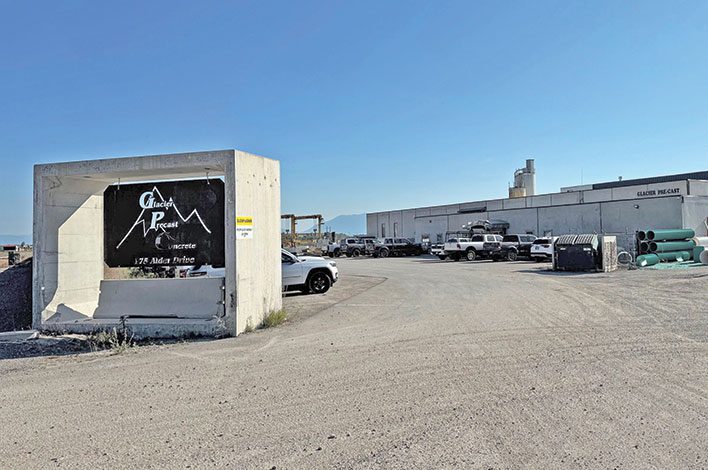
Nestled in the rugged beauty of Montana, Glacier Precast has evolved from a modest regional player into a thriving, forward-looking manufacturer of precast concrete products. Since its founding in 1989, the company has steadily expanded in both size and ambition. Today, it stands as a prime example of how local manufacturing can scale without losing its community roots or values.
The growth story of Glacier Precast is not just about production volume or facilities — it’s a story of people, purpose and vision.
A New Beginning
Glacier Precast began as a small operation founded by Pat Siemens in 1989. After a decade, it was sold to Tom Anderson, who transformed the business from a three-person outfit to a 23-person operation and built the company’s first dedicated batching plant in 2007.
In 2020, amid the uncertainties of a global pandemic, engineer and Navy veteran Erik Powell — now the president and owner of Glacier Precast — acquired the company.
“I didn’t know anything about concrete, but I knew manufacturing and engineering,” Powell said. “At first, I kept most things the same and just focused on learning how the business operated.”
Even the uncertainty of COVID-19 didn’t deter Powell from moving forward with the purchase of the company.
While many businesses struggled during the pandemic, Glacier Precast not only survived — it thrived, according to Powell.
“COVID probably helped us, to be completely honest,” Powell said. “Glacier Precast was deemed an essential company, so we never had to shut down and we were able to continue operations throughout the pandemic.”
Powell’s background — from running nuclear reactors aboard the USS Carl Vinson to managing manufacturing operations in Germany — has shaped how Glacier Precast operates today.
“This is by far the most fun job I’ve ever had,” Powell said. “There’s a lot of engineering involved, everything from structural design to troubleshooting electrical issues when equipment breaks.”
Under Powell’s leadership, Glacier Precast doubled in size and expanded to nearly 50 employees. But perhaps more remarkable than the financial growth has been the transformation in company culture and operational structure.
Powell brought a unique blend of engineering discipline and human-centered leadership to Glacier Precast. He approached the business with a commitment to continuous improvement.
“When I first took over, I didn’t want to change too much right away,” Powell said. “I used many of the systems that were already in place. But gradually, we started implementing production scheduling meetings, sales funnel meetings and lean processes. Then came SOPs, training videos and a structured training program using NPCA’s Master Precaster curriculum.”
This focus on standardization and workforce development allowed Glacier Precast to scale without sacrificing quality or efficiency. The implementation of Concrete Vision, an end-to-end precast management software, helped streamline everything from inventory tracking to project scheduling.
One of the company’s most impactful figures is the current CFO and plant controller Doug Hammerberg, who previously served as an estimator and project manager for 13.5 years before retiring in 2020 for personal reasons. Hammerberg later rejoined the company in 2023, inspired by Powell’s vision and dedication to Glacier Precast.
“I retired to come back to work,” Hammerberg said. “I’m 70 years old, and I don’t have to be here, but I want to be. The culture, the people, the direction — this is a company worth being part of.”
He now oversees financial operations, advises on business expansion and helps guide strategic purchases of equipment and forms. His history with the company and decades of experience in heavy civil construction and commodity trading make him a critical asset to Glacier Precast’s leadership team.
More than a Business
Beyond its products and profits, Glacier Precast has undergone a profound cultural transformation. As Powell took the helm, he emphasized not just productivity but also people.
Under his leadership, the company introduced paid holidays, PTO, 401(k) plans and competitive wages — all significant steps in a region where such benefits were historically rare. With the cost of living in Montana rising steeply, these changes made a real difference for workers.
“We want people to be able to live here, not just survive,” Powell said. “The profitability of the business allows us to invest back into our employees — with benefits, with training, with dignity.”
That investment also manifests in smaller but meaningful gestures like continuing the tradition of buying meat from the local 4-H fair for employee distribution, hosting annual Christmas parties or installing washer-dryer units for employees in need.
“There were guys living in their cars last year,” Hammerberg said. “Erik didn’t think twice to put in a washer and a dryer here at the plant. That’s the kind of leadership that makes you want to come to work.”