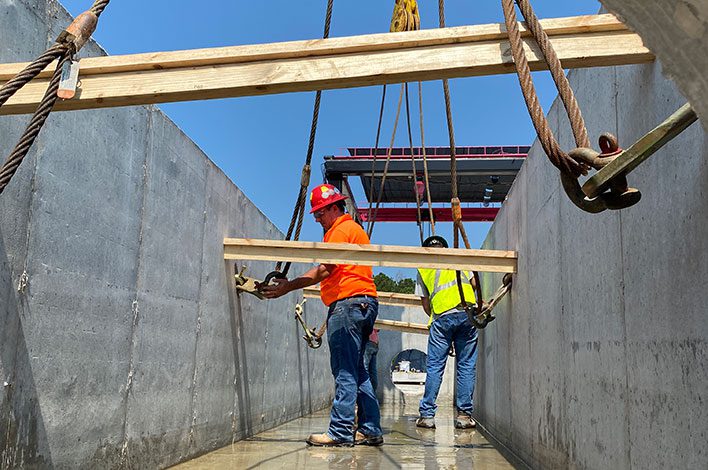
When a major chemical plant in St. Gabriel, La., needed to route piping beneath Hwy 75 at a levee crossing, downtime wasn’t an option — and neither was a traditional concrete solution.
The highway in question isn’t just any road. Highway 75 is the arterial lifeline for a dense corridor of chemical plants in the region, and closing it even briefly triggers a deep impact in the local industry.
“When you shut down a major highway that feeds all the chemical plants, there’s millions of dollars of potential lost revenue,” said Cyndi Glascock, business development at Gainey’s Concrete Products in Holden, La.
The project demanded speed, precision and a partner willing to think differently.
Originally, engineers had specified a cast-in-place structure for the pipe casing crossing. But as planning advanced, the team recognized the approach would introduce too many variables, like weather delays, potential for quality inconsistencies and extended road closures.
The design was converted to precast, a move that would improve constructability, reduce installation time and give the contractor a far cleaner scope of work in a sensitive, high-traffic environment.
“With precast, the only limiting factor is that it’s transportable,” Glascock explained.
From One Box to Two
Despite the flexibility of precast, the engineering solution that emerged wasn’t simple. The original concept called for a single large extended-base structure, but the width made it impossible to transport. The design teams cycled through three or four design iterations before landing on the final configuration. Ultimately, the design was split into two custom precast concrete pipe casings, each 6 feet wide and 36 feet long, weighing approximately 115,000 pounds each.
The decision to go with two separate units didn’t just solve the weight problem. It also simplified field handling and gave contractors greater flexibility during placement. The project’s partners, including Sigma Engineering, Delta Engineering, Deep South Cranes, ALP Supply, and SKR.
Contractors, coordinated closely around a timeline and expectations that left almost no margin for error.