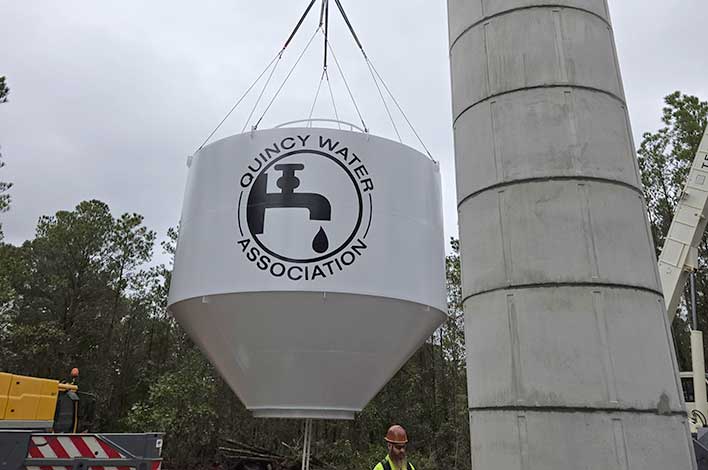
Known for versatility and durability, precast concrete is pushing into new territory — elevated water tank support systems
Traditionally, carbon steel has been the support structure for water storage tanks. But it has several disadvantages when used as a water storage tank support structure. Steel support structures require regular maintenance, such as repainting, to deter rust. In addition, mid-air maintenance increases maintenance costs and poses a safety hazard.
There is now an alternative to carbon steel. Chairman of the Board and Chief Technical Officer Benjamin Johnston of Pittsburg Tank & Tower Group (PTTG) and Jerry Smith, P.E., former development engineer for special projects at PTTG, developed a revolutionary system—Mini Composite Elevated Tank—using precast concrete segments. PTTG, located in Henderson, Ky., received its patent for the new product in December 2025.
The first two water storage tanks to utilize the new technology were built in Purcell, Mo., and North Hampton, Ohio.
“The biggest challenge, as with any new product, was getting people to believe in it,” Johnston said. “Fortunately, we had a good engineer and good owners who understand the value of looking at new concepts and not being afraid.”
PTTG found the Quincy Water Association bid on a government bid site. The association needed a new 100,000-gallon elevated water tank with a high-water line of 89.5 feet. To secure project funding, the project had to be finished within a set deadline. The project was necessary to meet the needs of the residents of Splunge, Miss. The bid originally specified a traditional elevated tank made from carbon steel. But when the association learned of PTTG’s precast concrete solution, it changed the specs for the job.
“This is a brand-new patented product that we’re rolling out to the marketplace,” Johnston said. “It’s the first one of its kind in Mississippi and only the third one in the United States.”
Precast Scores Major Points
Precast concrete has many advantages over other building materials. It is durable, long-lasting and nearly maintenance-free.
According to Johnston, economics was the primary reason precast concrete was selected over carbon steel for the Quincy Water Association project.
“When you look at the life cycle cost analysis of the tank, the precast segments that support the tank never require any maintenance or service,” Johnston said. “This product offers long-term benefits and cost savings.”
In addition, 70% of the man-hours used to build a precast concrete tank support are completed on the ground rather than in mid-air. This greatly improves safety. Producing the precast elements in a plant environment ensures a superior quality over using cast-in-place concrete. And concrete is a sustainable material.
Using local precasters for each project is also a plus for everyone.
“Putting part of the project cost dollars back into the local community is very important,” Johnston said.
Rising to the Occasion
PTTG selected Lee’s Precast Concrete, an NPCA-certified precast manufacturer based in Aberdeen, Miss., to fabricate the precast tower riser elements for the Quincy Water Association.
“We felt like it was within our realm of capabilities,” said Allen Lee, general manager for Lee’s Precast Concrete. “We already produce manhole structures, though not in that large of a diameter, and we have a 50,000-pound crane capacity.”
PTTG sent its patented Manway riser molds to Lee’s Precast and provided training on the setup to ensure the resulting precast elements met PTTG’s specifications.
Lee’s Precast used a 5,000-psi self-consolidating concrete with entrained air to protect the precast elements from freeze-thaw cycles.
To reinforce the precast tower riser elements, Lee’s Precast used a blend of wire cages and rebar. No. 6 U-bars were placed around the connection points of the tower risers and No. 3 vertical bars, at 12 inches on center.
“The spacing between the two cages had to maintain a certain clearance of steel on the inside of these ring sections, and we had to maintain a certain amount of cover on the reinforcing steel for the outside cage to ensure long-term structural integrity,” Lee said.
The decision to use rebar was left to Lee’s Precast.
“The benefit of having a flexible design is we can sit down and discuss with the precaster what needs and methods work best for them, what makes the design work for them,” Johnston said. “We don’t have to dictate their process.”
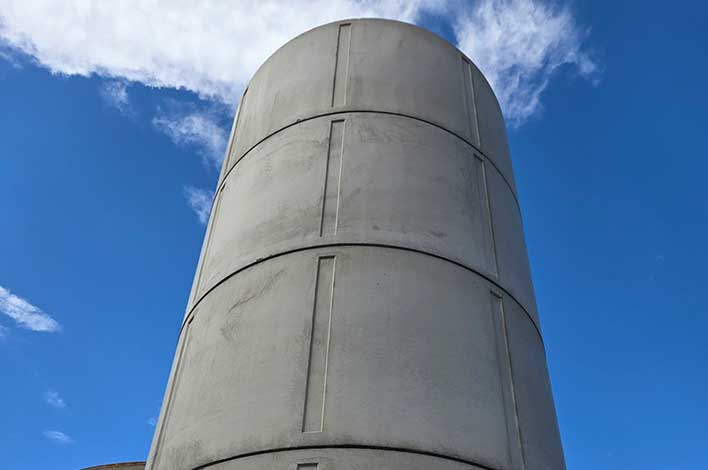
In all, Lee’s Precast produced 11 stackable tower riser elements. Each 6-foot element weighed 22,500 pounds, had an outside diameter of 11 feet 11 inches, and walls 8.5 inches thick.
Nine of the 11 precast risers are identical, but two are different to allow the plumbing to be accessed. And while most risers have a joint, these tower risers have embedded connections that fasten everything in place.
“Our biggest challenge was how much labor it would take to put the embeds in place,” Lee said. “But our guys are always up for a challenge.”