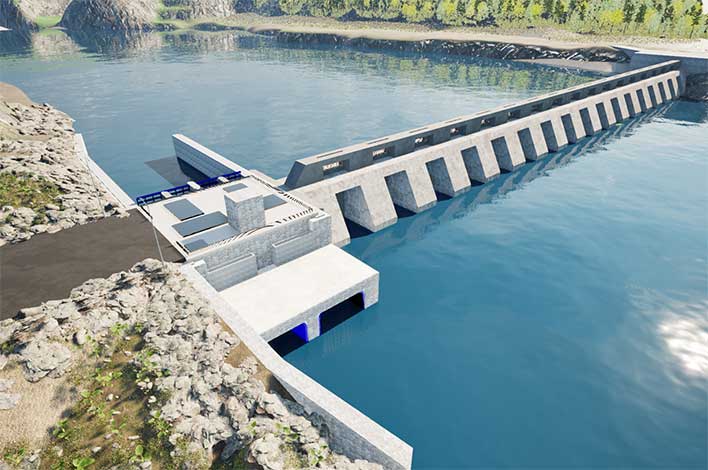
As climate targets tighten and utilities seek carbon-free baseload power, precast concrete is stepping in to help to build new hydroelectric dams.
Hydropower generates 38% of the country’s renewable electricity, the largest share of any renewable source in the U.S. It’s the most flexible renewable source because operators can ramp production up or down to balance the grid when solar and wind fluctuate. As climate targets tighten and utilities seek carbon-free baseload power, the construction of new hydroelectric dams is underway.
The nation’s 92,000 dams average 64 years old, and 70% of them will surpass the 50-year mark by 2030, according to the American Society of Civil Engineers. Engineers built most of these dams for flood control and irrigation using design standards that don’t account for today’s weather patterns or the downstream development that has happened since.
With the Infrastructure Investment and Jobs Act allocating $3 billion toward dam safety projects, utilities are taking hydroelectric power more seriously. In the U.S., researchers estimate that roughly 12 gigawatts of new capacity could be developed at non-powered, government-owned facilities, with another 65 gigawatts available through run-of-river projects nationwide. At Oak Ridge National Laboratory, researchers have identified modular precast dam systems as a major construction breakthrough because it allows dams to be built faster and with less on-site risk than traditional cast-in-place methods.
“There’s a speed-to-power imperative underway in the country right now,” Bill French, CEO of FDE Hydro in Chelmsford, Mass. said.
Rapidly deployable modular precast, like FDE’s French Dam, is considered the biggest innovation in hydropower in the last 60 years.
“We need baseload energy to run artificial intelligence (AI), the manufacturing resurgence in the U.S. and the electrification of our nation,” French said. “Hydropower is being unleashed and included as a key baseline energy source along with oil, gas and nuclear.”
New Dams On the Way
Building hydroelectric powerhouses requires an expansive concrete infrastructure. The concrete work alone represents a significant portion of project timelines and costs: structures are needed to hold the turbines and generators; penstocks (large pipes) have to run from intake structures through the dam to deliver water to the turbines; and tailrace channels that return water to the river downstream must be put in place.
Using cast-in-place adds time and complexity to these projects as crews spend months pouring and curing concrete on-site. Weather delays alone can derail even the best-planned project schedule and quality control takes place after the pour, when it’s already too late to fix problems without major rework. French says these factors push projects out by years and drive up costs, making some projects financially marginal despite their power potential.
Precast manufacturers recognized an opportunity to get into the game. After all, bridge builders and road crews had moved to factory-built concrete modules decades ago. Why couldn’t dam construction follow the same path?
At French’s invitation, Wieser Precast in Portage, Wis., sent its president, Mark Wieser, to Washington, D.C. in April to meet with the Department of the Interior and federal agencies working on hydropower development. There, precast manufacturers, hydropower developers and government officials discussed the case for modular precast construction on new dam projects. Wieser and other precasters extolled the benefits of using prefabricated concrete modules to replace the traditional approach of pouring concrete on-site.
“Our big point to them was the safety of the project, the construction time being way less than the quality control side of precast versus doing everything on site,” Wieser said.
Instead of crews spending months at a dam site mixing and pouring concrete while fighting weather and waiting for cure times, manufacturers can build modules in controlled plant environments and ship them ready for installation.
“A project can start and finish so much faster that way compared to casting in place,” Weiser added.