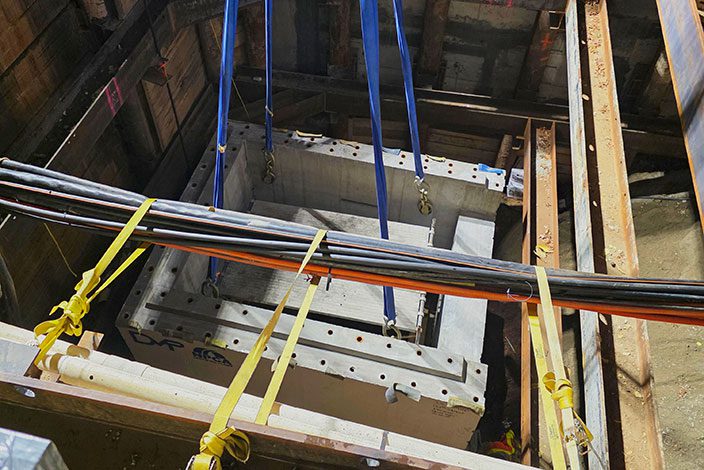
A five-section precast elevator shaft advances ADA access in Manhattan.
Anyone who’s ever had to navigate steep, narrow subway steps down into a dimly lit underground station during rush hour knows how perilous the experience can be. Add a walker, stroller or heavy suitcase to the mix and the situation can get dangerous pretty quickly. That’s one of the reasons the Metropolitan Transportation Authority (MTA) is in the middle of a long-term push to make more of New York City’s subway system accessible.
Under a 2022 agreement with disability rights advocates, the MTA is making 95% of currently inaccessible subway and Staten Island Railway stations accessible by 2055. Precast concrete is playing a role in that shift, and proving to be a good fit in a city where onsite construction amid the densely packed buildings, high pedestrian traffic volumes and busy streets is extremely difficult.
The project team took a new approach with the new elevator shaft at the 137th St-City College subway station in Manhattan’s Hamilton Heights neighborhood. The station is on the MTA New York City Subway system’s No. 1 line, where the new elevator (EL520) will help riders enter and exit the southbound, Manhattan-bound side of the station. This project will be completed Sept. 30.
A Better Option for a Busy Site
The station previously had no elevators, which made accessibility difficult at best. It’s also located in a tight, congested neighborhood where construction space is limited, DOT permits and traffic rules have to be managed, and multiple contractors share a very small footprint and staging area.
Forming, pouring and curing concrete in that environment would have added labor, time and complexity to an already difficult project. Instead, the project team used a precast elevator shaft system that was manufactured offsite while the general contractor continued with other work.
J-Track TCE Joint Venture (JTTC JV), the general contractor for the project, hired Deihl Vault & Precast Inc. (DVP) as the subcontractor for the elevator shaft. Robert Stepien Jr., a field engineer with TCE, says the idea to use precast grew out of a need to solve some of the problems associated with construction in New York City.
“A former colleague was experimenting and trying to figure out a way to solve some problems around construction in the city,” Stepien said, “and that’s where they figured out the precast idea.”
John Cerva, president of CSDS LLC in Gilbertsville, Pa., served as the specialty engineer of record for the precast system. This was the second precast elevator shaft he’d engineered for New York City’s subway system, and he expects the approach to become more common. He prepared the drawings and verified the designs for the 137th St-City College precast elevator shaft, and says precast was the natural choice based on the site constraints, labor requirements and the need to shift as much of the work as possible out of the field.
“Rather than having all the formwork and materials go to the site, and then be managed by people onsite, it’s all done in a controlled environment inside a precast plant,” Cerva said. “Manufacturers can pretty much consistently pour every day in that environment.”
Producing in a plant setting becomes even more valuable when the alternative is building inside a hole in the middle of Manhattan.
“In this case of an underground elevator shaft, using precast helps with manpower and to control the environment that you’re setting everything up in,” Cerva said. “Rather than being down inside a hole, you’re working within that controlled environment.”
That controlled environment also isn’t subject to weather-related delays and other external factors. Cerva uses this simple analogy: It’s the difference between doing detailed desk tasks in an office and trying to do the same thing outside in the wind and rain, with people walking around you.
“Some of this work was done in the middle of the night,” he continues. “That made it much easier to do the work on a typical day shift with the help of the indoor climate, instead of having to adjust for all the different temperatures and weather conditions.”
Five Sections, Tight Tolerances
The 137th St-City College elevator shaft is made up of five separate precast split sections, each of which weighs about 50,000 pounds (25 tons). That segmented approach made transportation and installation easier, but it also made precision critical. The pieces had to be stacked precisely, and the reinforcing steel matched up from section to section.
“The elevator shafts are put together in a unique way,” Cerva said. “Instead of using continuous rebar that you have in cast-in-place, it all ends up being spliced into these segments that go on top of each other.”
That left very little room for error.
“The tolerance for rebar matching up when you go from section to section is very minimal,” Cerva said. “We’re talking plus or minus a quarter of an inch.”