Precast manufacturers are using automation to ease labor gaps, improve consistency and keep production moving
White-collar jobs may be harder to come by these days, but the U.S. manufacturing and construction sectors are still dealing with an ongoing labor shortage. Shifting more work from the jobsite to the precast plant can help make up for construction labor shortages in the field. In many cases, though, that just pushes the problem into the plant, where finding people to do hard, physical production work has gotten more difficult over the last few years. The Manufacturing Institute and Deloitte predict that nearly 2 million manufacturing jobs could go unfilled by 2033 if manufacturers can’t address current applicant and skills gaps.
This isn’t a new problem, but lately it just keeps rolling over into each new year. What first became a key concern during the fourth quarter of 2017 has only been exacerbated by the pandemic, the silver tsunami retirement wave, skills gaps and the fact that many younger workers favor white-collar jobs over plant-floor roles. That leaves a significant gap in the potential labor pool for precasters, some of whom are filling the void with automated equipment and systems that can help with planning, batching, reinforcing, product handling and some of the heavy lifting.
Automation isn’t an even swap for human workers, but it can help plants get more done with the teams they have. Automated batching systems improve mix consistency; laser projection helps crews place embeds and blockouts; and rebar bending and cage-making equipment reduces repetitive manual work. Other tools work farther upstream or downstream, where automated curing controls help producers manage temperature and moisture, and plant software can schedule production and track products from casting through delivery.
It Doesn’t Take a Village
At DZ Precast, Vice President of Engineering Mansoor Illahi says labor market conditions drove the company and its customers to look harder at automation. The Villages, a large master-planned community in Central Florida, began looking at precast during the pandemic, when labor and material shortages made traditional block construction harder to manage.
“They didn’t have the people to lay the blocks because employees weren’t coming to work, and then we also had material shortages right around that time,” Illahi said. “They decided to look for alternatives.”
That search took the development team overseas, where precast housing was already being used in Germany and the U.K. It also led the company to Progress Group, which introduced the team to a more automated precast production model. From there, a precast plant was built to support the housing program. That program is on a rigorous buildout schedule. According to Illahi, The Villages builds about 12 houses a day, and each home has about 27 to 30 wall panels.
DZ Precast now produces panels for about 65% to 70% of that volume, or roughly eight to nine houses a day.
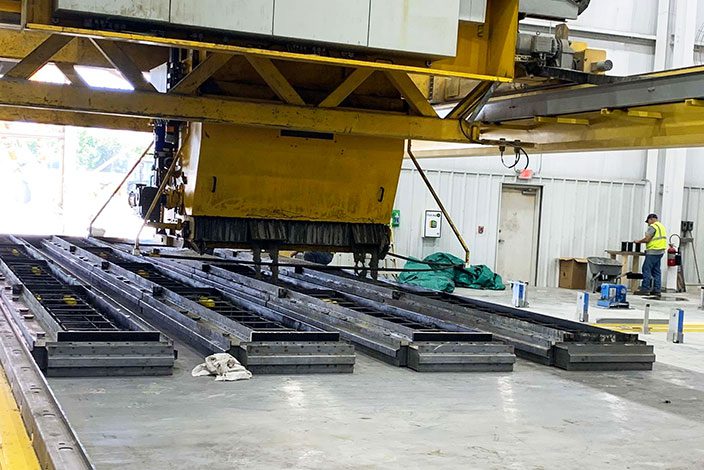
To hit those production goals, the plant uses a semi-automated carousel system, three robots and a pre-production digital process. DZ Precast models each house in a design software called Tekla, creates the drawings, then sends PXML files into the production system. Those files tell the equipment what needs to be made, where the openings go and how the wall panels should be formed.
Each new home is treated as its own job, with the team modeling and engineering it, creating the drawings and sending the production data into the plant system. From there, the robots and operators take over. The system uses the PXML file to place the shutters that form each wall’s perimeter, while laser projection helps crews place embeds, window openings and reinforcement details. A rebar welding machine creates the mats for each table, stores them until needed and feeds them into the production flow, where a robot places each mat.
Operators still handle the judgment-based work, including loose reinforcement around openings, grout tubes and lifters, as well as finishing. Once the panels cure overnight at about 125 degrees Fahrenheit with moisture control, both the machine and plant personnel will verify the stripping strength before the panels are removed and the shutters are cleaned, oiled and stored for reuse.
With 45 tables running during one shift and about 40 at night, DZ Precast produces more than 200 pieces per day, every day.
“In a traditional system, if you have to produce 10 walls, it’s almost a 24-hour operation,” Illahi said. “With this, the forming is done in five minutes.”
Small Parts, Higher Volume
Automation looks a little different at EZ-Crete LLC, where the focus is on smaller precast products produced in higher volumes. Owner Brice Raynor says the company runs parts weighing about 300 to 400 pounds or less through its automated systems, including its patented, stackable modular deck footing.
“It’s basically a drop-in for Sonotube,” Raynor said. “You don’t have to mix concrete or wait for it to cure.”
EZ-Crete began moving seriously into automation in 2019, after watching customer expectations shift toward tighter tolerances, better quality control and higher throughput. Safety was the biggest driver.
“A lot of businesses talk about safety being number one, but you have to act on that,” Raynor said. “Spending those meaningful dollars on automation shows your team that you’re willing to act on it.”
To get the most out of automation, Raynor says precasters should prepare employees for a different kind of plant-floor role, one that involves operating, learning and troubleshooting automated equipment instead of just doing the heavy lifting. He also suggests working with a competent systems integrator.
“Have a third-party integrator lined up and ready to go,” he said. “It doesn’t matter what you buy, it’s not just going to go in and start working on day one.”