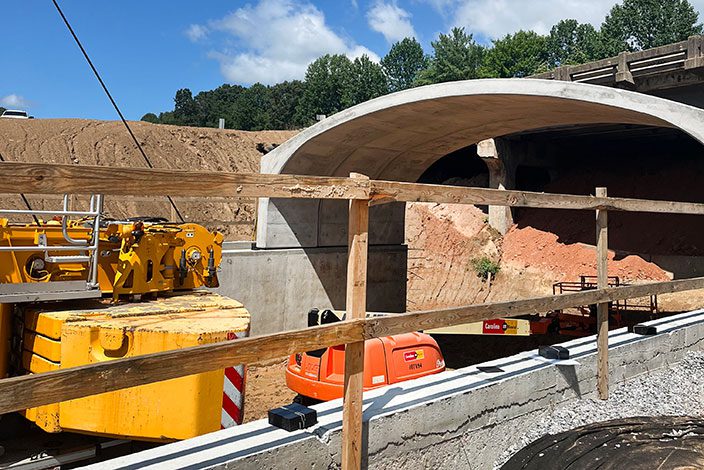
Two aging bridge replaced by precast arch culver tunnel
Two aging bridges along Interstate 40 in Canton, North Carolina, have carried traffic for decades. Now they’re being replaced by something the state has never built before: a precast arch culvert tunnel running beneath the interstate itself.
Tindall Corporation manufactured and delivered the precast arch segments for the project, engineered for a 100-year service life and designed to accommodate future corridor widening. Just as important to the North Carolina Department of Transportation, the system allows construction to proceed safely beneath the roadway, without shutting down the highway above.
“It’s a very versatile product that works for multiple applications,” said Bob Lawson, business development engineer at Tindall. “We’ve made these for E80 railroad loading. We’ve made them for underground people movers at international airports. But every project is different.”
A Tunnel Where Two Bridges Stood
The Canton project called for a 36-foot span with an 11-foot interior height, tall enough to carry two lanes of traffic beneath the arch. The precast sections sit atop cast-in-place walls roughly 11 feet tall, a hybrid approach that lets Tindall ship a product narrow enough for the road while giving the contractor room to build up the final height on-site.
The full tunnel system runs 170 to 180 feet, assembled from 29 precast sections, each about six feet long and weighing 57,000 pounds. Because the project was phased and built in two separate mobilizations, Tindall cast precast head walls at each end to restrain earth pressure and installed temporary head walls mid-arch to hold the line between phases.
Phase 1 alone saw the crew set 17 precast segments in just two days using a 275-ton crane. The project is expected to reach completion in April 2028.
Engineering the Fit
Getting a precast structure to marry cleanly with cast-in-place walls demands a concrete mix built for both strength and finish. Tindall used a 7,000-psi self-consolidating mix at its Fairforest, South Carolina., plant, stripping pieces from the form every 24 hours.
“We had to meet the North Carolina DOT’s requirements on stripping strength before we can strip them off the form,” Lawson said. “That’s different in summertime than it is in the wintertime, but we’re able to adjust our mixes as we need to.”
Quality control ran on two tracks simultaneously.
“We do have a pre-pour and a post-pour check sheet. We have in-house quality control, and on top of that, because it’s an NCDOT job, we have to have an NCDOT inspector come to inspect these pieces before we’ll ever ship it,” said Joe Fiddermon, project manager at Tindall.
Weather independence gave Tindall a scheduling edge the site itself couldn’t match.
“All of our raw material storage at our plant is inside — our aggregate storage, our cement storage,” Lawson said. “So, we are basically unaffected by the weather. That helps us produce faster than they’re going to be ready on site.”